Custom Token Exchange
RFC 8693 · Exchange any external token format for Auth0 AT + ID Token + RT · Auth0 Action validates and maps identity
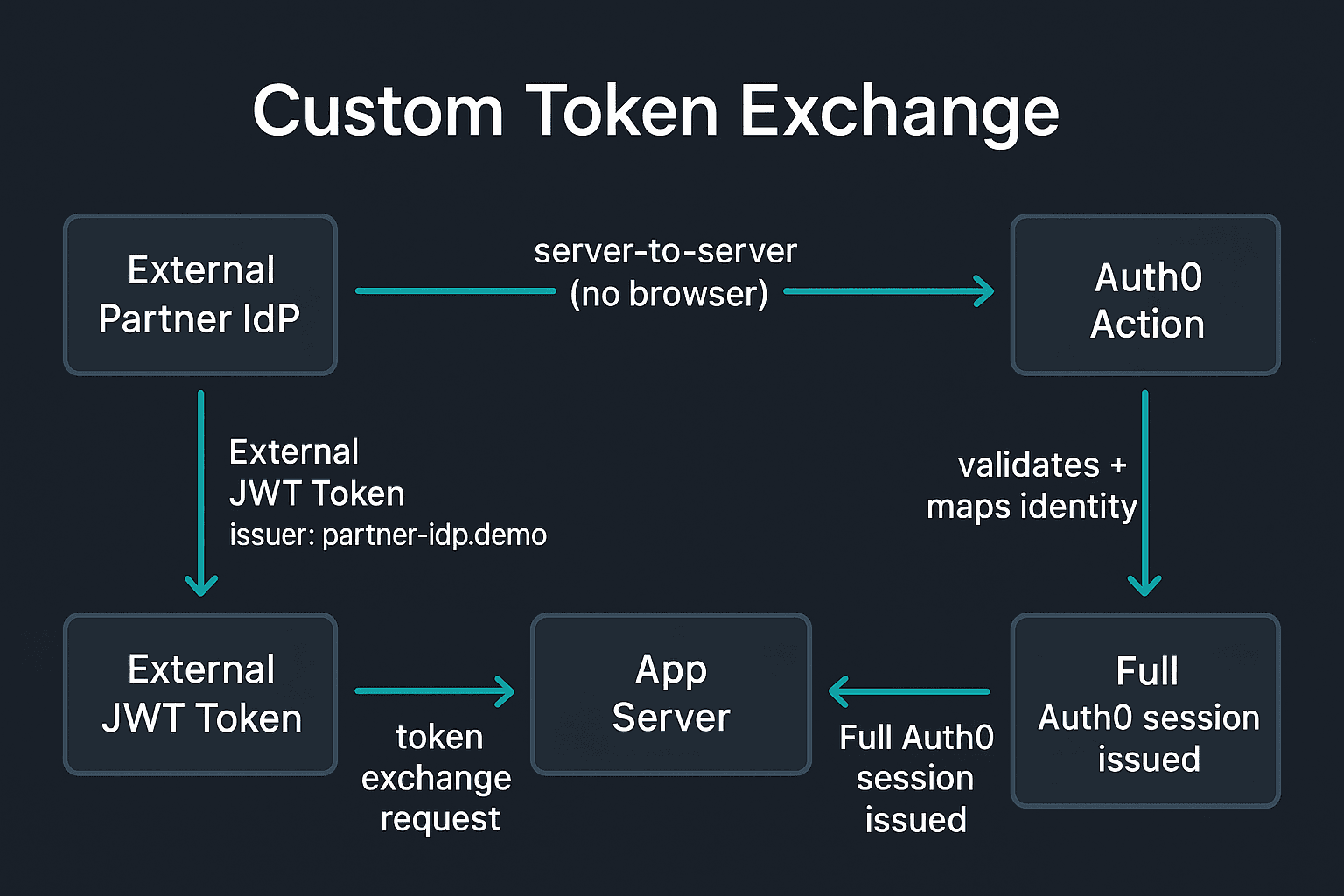
External Partner JWT
Auth0 /oauth/token
CTE Action validates + setUser()
Auth0 AT + ID Token + RT
The external token can be any format — JWT, SAML, arbitrary string. The Auth0 Action is responsible for validation and identity mapping. No browser redirect; no Universal Login. The result is a full Auth0 session.
name
role
Issuer is fixed at https://partner-idp.demo and the token is HS256-signed with the same secret the Auth0 Action uses to verify it.
newpartner@atko.email.Any token format accepted— the external token can be a JWT, SAML assertion, or arbitrary string. The Auth0 Action owns validation entirely; Auth0 enforces nothing about the incoming format.
No browser redirect— unlike a standard Authorization Code Flow, CTE is a server-side token endpoint call. The user never sees Universal Login. This makes it suitable for system-to-system authentication (external IdP federation, migration scenarios, device attestation).
Full Auth0 session issued— on success, Auth0 returns an AT, ID token, and optionally a refresh token. The application gets a complete Auth0 identity for the user, even though that user authenticated via an external system.
Security responsibility— Auth0 explicitly places validation on the implementer. The demo Action verifies the HS256 signature and the issuer URI; a production Action would verify against a public key from the partner's JWKS endpoint and enforce expiry.
Strengths
- Accepts any external token format (JWT, SAML, arbitrary string) with no browser redirect — useful for external IdP federation and migration without touching Universal Login.
- Produces a full, standard set of Auth0 tokens (AT + ID token + RT) regardless of how exotic the inbound token is — though note this is a token exchange, not a browser session: no Auth0 AS session cookie is ever created, consistent with there being no redirect at all.
Risks & Considerations
- Auth0 explicitly delegates all validation to the Action — there is no framework-level check on the incoming token. A weak or missing validator is a complete authentication bypass.
- This demo signs the external JWT with a shared HMAC secret for simplicity; that's not how a real partner integration should authenticate its tokens.
Hardening Checklist
- In production, verify against the partner's real JWKS endpoint, not a shared symmetric secret.
- Enforce issuer, audience, and expiry checks explicitly inside the Action — don't assume Auth0 checks any of it for you.
- Log every exchange attempt (success and failure) for audit; this endpoint is effectively a second front door to your tenant.